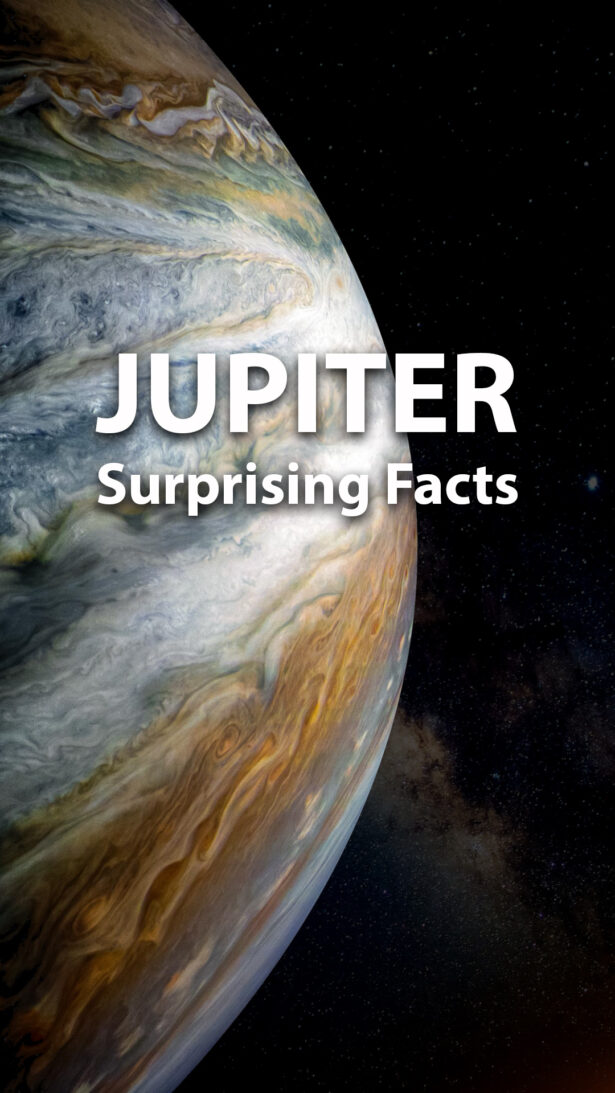
Our Solar System’s Largest and Most Colorful Planet
🌟✨ Discover the wonders of the largest planet in our solar system, Jupiter in this cosmic 4K video adventure! 🚀🔭 From its vibrant, banded clouds made of ammonia and sulfur to the awe-inspiring Great Red Spot—a storm that’s raged for centuries—Jupiter’s secrets are as vast as its size. 🌌 Explore Jupiter’s enormous magnetosphere, which is 15 times wider than the Sun, and learn how it creates stunning auroras. 🌠 Plus, get to know its fascinating moons, including the volcanic Io and the icy Europa, which might harbor a hidden ocean! 🪐🔍 Don’t forget to hit like, share with fellow space fans, and dive deeper into Jupiter’s mysteries! 🌍🔭
Video credits: NASA and Pixabay
Script and Video Editing: Jef Gray
Production: International Peace and Film Festival
Video Transcript
1
00:00:00,566 –> 00:00:03,600
interesting facts about the planet Jupiter.
2
00:00:03,600 –> 00:00:04,600
Jupiter’s colourful
3
00:00:04,600 –> 00:00:07,400
banded appearance is created by clouds of chemicals
4
00:00:07,400 –> 00:00:09,433
such as ammonia sulfur
5
00:00:09,500 –> 00:00:11,066
phosphorus and carbon.
6
00:00:11,133 –> 00:00:13,333
the Great Red Spot on the surface of Jupiter
7
00:00:13,333 –> 00:00:14,800
is a massive and persistent
8
00:00:14,800 –> 00:00:16,133
anti-cyclonic storm
9
00:00:16,133 –> 00:00:18,166
that has been observed for centuries.
10
00:00:18,166 –> 00:00:19,900
there are numerous other festoons
11
00:00:19,900 –> 00:00:21,633
or storms that come and go,
12
00:00:21,700 –> 00:00:22,866
but the Great Red Spot
13
00:00:22,866 –> 00:00:25,566
seems to be a fixture in Jupiter’s atmosphere.
14
00:00:25,666 –> 00:00:28,100
of all the planets in our solar system,
15
00:00:28,166 –> 00:00:29,733
Jupiter is the largest,
16
00:00:29,733 –> 00:00:33,133
with a volume more than 11 times the diameter of Earth.
17
00:00:33,133 –> 00:00:35,166
Jupiter’s intense magnetosphere
18
00:00:35,166 –> 00:00:37,866
is the largest object in our solar system,
19
00:00:37,866 –> 00:00:40,300
and is 15 times wider than the sun
20
00:00:40,500 –> 00:00:43,400
this magnetic field creates intense radiation
21
00:00:43,400 –> 00:00:45,000
by accelerating particles
22
00:00:45,000 –> 00:00:47,266
that are pulled toward the magnetic poles,
23
00:00:47,266 –> 00:00:48,500
resulting in auroras
24
00:00:48,500 –> 00:00:50,633
that are visible in ultraviolet light.
25
00:00:50,766 –> 00:00:52,400
most of the charged particles
26
00:00:52,400 –> 00:00:54,766
that Jupiter’s magnetosphere sweeps up
27
00:00:54,766 –> 00:00:56,500
come from the gases of Io,
28
00:00:56,500 –> 00:01:00,766
Jupiter’s volcanic moon. Europa is Jupiter’s ice moon
29
00:01:00,766 –> 00:01:04,300
which has a smooth surface and a minimal impact craters.
30
00:01:04,300 –> 00:01:06,933
it is possible Europa has a subsurface ocean
31
00:01:06,933 –> 00:01:08,866
that could potentially harbor life.
32
00:01:08,966 –> 00:01:10,933
the known number of moons around Jupiter
33
00:01:10,933 –> 00:01:13,166
continues to grow as they are discovered,
34
00:01:13,166 –> 00:01:13,800
but currently,
35
00:01:13,800 –> 00:01:16,966
NASA has counted 95 moons in Jupiter’s orbit.
36
00:01:17,100 –> 00:01:22,033
in 1979 Voyager 1 made a historic fly by of Jupiter
37
00:01:22,266 –> 00:01:25,266
providing the first close up images of Jupiter’s moons,
38
00:01:25,266 –> 00:01:26,300
and atmosphere.