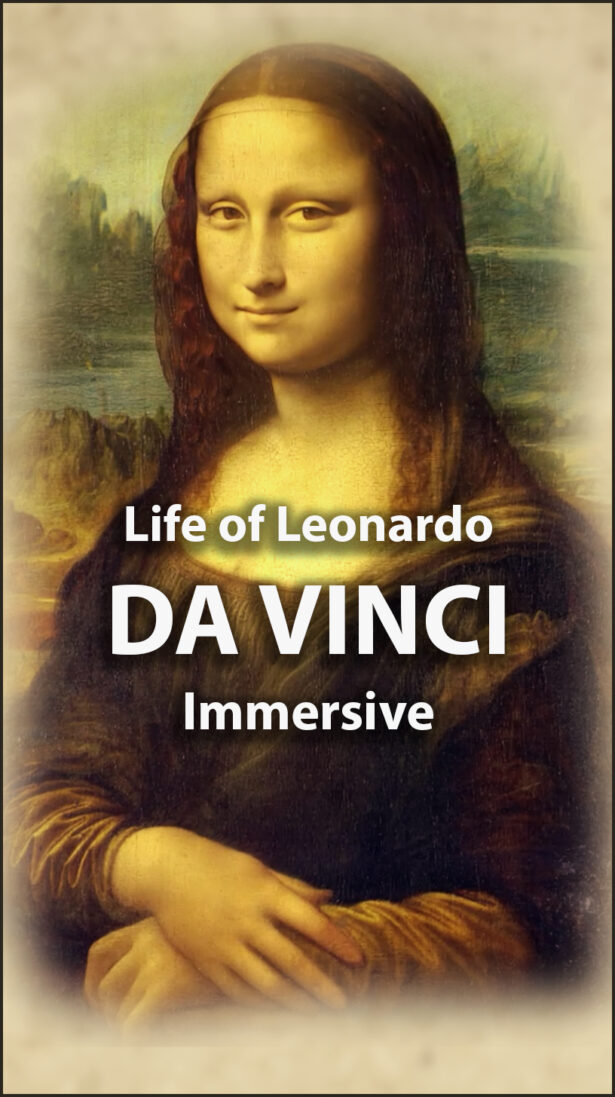
An immersive and three dimensional documentary of the ultimate renaissance man, Leonard Da Vinci
Leonardo da Vinci: Artist, Inventor and Renaissance Visionary
Explore the life, artwork and extraordinary ideas of Leonardo da Vinci through
an immersive three-dimensional documentary. The video examines the curiosity
that made Leonardo one of history’s most influential artists, engineers,
anatomists and scientific observers.
Who Was Leonardo da Vinci?
Leonardo da Vinci was born on April 15, 1452, near Vinci in Tuscany, in what
is now Italy. He was the son of Ser Piero, a Florentine notary, and a woman
named Caterina. Because his parents were not married, Leonardo did not follow
the conventional educational path available to the legitimate sons of
professional families.
His full name is commonly recorded as Leonardo di ser Piero da Vinci:
Leonardo, son of Ser Piero, from Vinci. The words “da Vinci” therefore identify
his place of origin rather than functioning as a modern family surname.
Leonardo received practical artistic training in Florence in the workshop of
Andrea del Verrocchio. There he developed skills in drawing, painting,
sculpture, mechanics and the preparation of materials. His career later took
him to Milan, Florence, Rome and finally France.
Leonardo’s Art, Science and Inventions
Although Leonardo is best known for paintings such as the
Mona Lisa and The Last Supper, his surviving notebooks reveal
a much broader range of interests. He investigated human anatomy, water,
geology, optics, mathematics, architecture, mechanics, weapons and the
possibility of human flight.
Leonardo filled thousands of pages with observations, diagrams and questions.
Approximately 7,000 pages of his notes and drawings are known to survive,
although scholars believe a substantial portion of his original work has
been lost.
Many of the machines shown in his notebooks were concepts rather than devices
that he constructed and tested. His flying machines, mechanical wings,
parachute-like designs, armored vehicles and hydraulic systems nevertheless
demonstrate his ability to combine close observation with imaginative
engineering.
Why Leonardo Still Matters
Leonardo’s importance lies not only in the answers he found, but in the way
he asked questions. He studied the movement of water, the structure of the
human heart, the flight of birds, the growth of plants and the effects of
light and shadow with the same persistent curiosity.
He did not treat art and science as separate disciplines. Anatomy helped him
understand the human figure. Optics informed his use of light and perspective.
Engineering strengthened his understanding of movement, force and proportion.
This union of observation and creativity remains one of the defining features
of his legacy.
Frequently Asked Questions About Leonardo da Vinci
Where was Leonardo da Vinci born?
Leonardo was born in 1452 in the countryside near Vinci, Tuscany. Tradition
identifies his birthplace as a farmhouse in the hamlet of Anchiano, a few
kilometers outside the center of Vinci. The property is now preserved as
the Casa Natale di Leonardo, or Leonardo’s Birthplace House.
Was “da Vinci” Leonardo’s last name?
Not in the modern sense. “Da Vinci” means “from Vinci.” His name identified
him as Leonardo, the son of Ser Piero, who came from the area around Vinci.
He is therefore usually referred to simply as Leonardo in historical and
scholarly writing.
Why did Leonardo write backward?
Leonardo was left-handed and frequently wrote from right to left in what is
called mirror writing. The text can be read more easily when reflected in a
mirror. One practical explanation is that writing in this direction reduced
the chance of his hand smearing wet ink, although privacy or personal habit
may also have influenced the technique.
How many notebook pages did Leonardo create?
Approximately 7,000 pages of Leonardo’s notes and drawings survive today.
The original collection was probably much larger, but there is no definitive
surviving count. Estimates such as 13,000 or 16,000 pages usually include
material believed to have been lost.
Did Leonardo da Vinci invent the helicopter?
Leonardo drew an aerial screw that is sometimes described as an early
precursor to the helicopter. It was not a working helicopter in the modern
sense, and there is no evidence that Leonardo successfully flew it. The
design is important because it demonstrates his effort to understand how a
rotating surface might generate lift.
Did Leonardo build his flying machines?
Most of Leonardo’s flying-machine designs remained on paper. He carefully
studied birds and designed mechanical wings, gliders and other devices, but
no reliable evidence shows that he achieved sustained human flight.
Was Leonardo da Vinci formally educated?
Leonardo did not receive the classical university-style education available
to some Renaissance scholars. He learned through artistic apprenticeship,
observation, experimentation, reading and collaboration. Later in life he
worked to improve his knowledge of subjects such as Latin, mathematics and
anatomy.
Was Leonardo da Vinci a vegetarian?
Leonardo is often described as a vegetarian because historical accounts
associate him with compassion toward animals. However, the surviving
evidence is not complete enough to establish every detail of his diet with
certainty. It is more accurate to say that he may have avoided eating meat.
Was Leonardo also a musician?
Renaissance accounts describe Leonardo as a talented musician and performer.
He was associated with the lyre and reportedly presented himself at the
court of Milan as both an artist and musician. Music formed another part of
his wide-ranging creative interests.
Did Leonardo keep the Mona Lisa until his death?
Leonardo appears to have taken the Mona Lisa with him when he moved
to France in 1516. Evidence suggests that he continued refining the painting
during the final years of his life. It later entered the French royal
collection and is now displayed at the Louvre Museum in Paris.
When and where did Leonardo da Vinci die?
Leonardo died on May 2, 1519, at Clos Lucé near Amboise, France. He had moved
there under the patronage of King Francis I and spent the final years of his
life working on artistic, architectural and engineering projects.
About This Leonardo da Vinci Documentary
This short documentary combines historical research, original artwork,
cinematic imagery and three-dimensional rendering to introduce Leonardo’s
life and ideas in a visually immersive format.
Research, script, video production, artwork and 3D rendering:
Jef Gray
Production: International Peace and Film Festival
Stock footage and reference imagery: Wikimedia Commons and
other appropriately licensed historical sources